Physical Address
304 North Cardinal St.
Dorchester Center, MA 02124
Physical Address
304 North Cardinal St.
Dorchester Center, MA 02124

Series – The Online Gambling Industry
My last article plunged into the serious world of gambling addiction – Article 17 – Is Gambling Good or Bad – and I concluded that for most people, it’s harmless entertainment and for a small minority — something like 5% of players generating 86% of the industry’s revenue — it’s closer to a wealth-extraction mechanism aimed at exactly the people least equipped to resist it.
I ended that piece with a line I wasn’t sure I entirely believed myself: maybe no one should be allowed to gamble without first passing some kind of proficiency test. I said I was open to discussion on that one. Now I’ve taking my own suggestion seriously enough to actually try building it.
The obvious version of this idea — a quiz you pass before you’re allowed to bet — turns out to be wrong in an interesting way. A knowledge test screens for the wrong thing. Someone can define the gambler’s fallacy perfectly and still chase losses under stress; someone else can be cautious by temperament and know almost nothing about how the games are built to win. A single pass/fail gate certifies articulate people with a real problem and fails cautious people with none.
It also runs into the same failure I already wrote about with GAMSTOP: a ban that’s purely punitive doesn’t reduce demand, it just redirects it — toward unregulated offshore operators with none of the protections a licensed one has. A single “you failed, you’re out” gambling test would leak the same way.
So instead of one test, I built two, scored separately.
Track 1 – The Honest Answer asks a different question than most people expect: not “do you know the odds,” but “is this a safe idea for you, right now.” It’s built on the PGSI (Problem Gambling Severity Index) — a validated clinical screening tool, not something I invented — plus a two-question rapid pre-check clinicians call Lie/Bet. Eleven questions, about five minutes, no personal information recorded. The result is a plain band — Clear, Elevated, or High — not a diagnosis, and support resources are shown regardless of what you score.
Track 2 – The Cynicism Test is the part that’s actually about competence: twelve genuinely non-trivial multiple-choice questions on house edge, expected value, and — the part I think matters more than the math — recognising the specific tactics used on you: Loss-disguised-as-a-win animations. Engineered near-misses. VIP-host outreach timed to a losing streak.
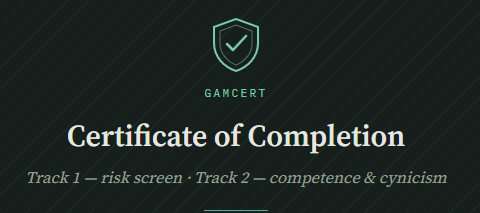
You get one attempt per question, no going back to fix an answer once you’ve seen you got it wrong. Score high enough, with no weak category, and you get a certificate. Tough but fair.
Please do note that this is a concept build, not a finished product — free, anonymous, and currently going through review before I’d call it something other than a prototype.
If you want to see what “a gambling proficiency test” looks like when you actually try to build one rather than just propose it in an article, press the button below and the certification will open in a new window.
Be honest and clever!
Press the button!
In 1996, a small sportsbook in Austria accepted the world’s first online sports bet: a $50 gamble that Tottenham Hotspur would beat Hereford United in a third round FA Cup replay.
Since then, the rise of the online gaming industry has been meteoric. From humble beginnings, in seedy apartments and dimly lit basements, visionaries and programmers created computer systems that would form the foundations of a remarkable industry.
This transformation has extended gambling opportunities in unprecedented ways. As each new system or service came online, it gained popularity and momentum, leading to rapid growth.
Today, the industry is worth a fortune, with a turnover calculated in the trillions of dollars. It pays significant taxes, contributes to worthy causes, offers investment opportunities, and provides employment to many.
This first article in the series “The Online Gambling Industry” outlines the origins of the industry; looking at the key innovations that contributed to the beginnings of the online gambling industry.
We will explore how these early developments set the stage for the thriving online gambling landscape we see today.
The following articles in this series will delve deeper into the evolution of the industry, revealing the pioneers and their ground-breaking contributions. Join us, as we uncover the fascinating history of online gambling!
Dear Reader,

I’m Ian Sherrington and thank you for your interest in this fascinating topic. As a programmer, I played a key role in the early days of the Online Gambling Industry. On January 17th, 1996 the first online sports bet was accepted by the new Intertops website which I had conceived and created. Intertops has been online and accepting bets ever since.
I’ve stayed in the industry and continue to innovate and contribute in various ways, not just technically. During my time I’ve witnessed the evolution of the industry first-hand.
I always wanted to write about the industry and how it came to be and uncover the innovations and the innovators, many of whom I have met, and their invaluable contributions.
Now I have the chance to do it so now I’m investigating .. Who did what, when and.. why?
Huge thanks to Paul and all for your patient editing!
Let the Series begin!
Ian Sherrington, July 2024